
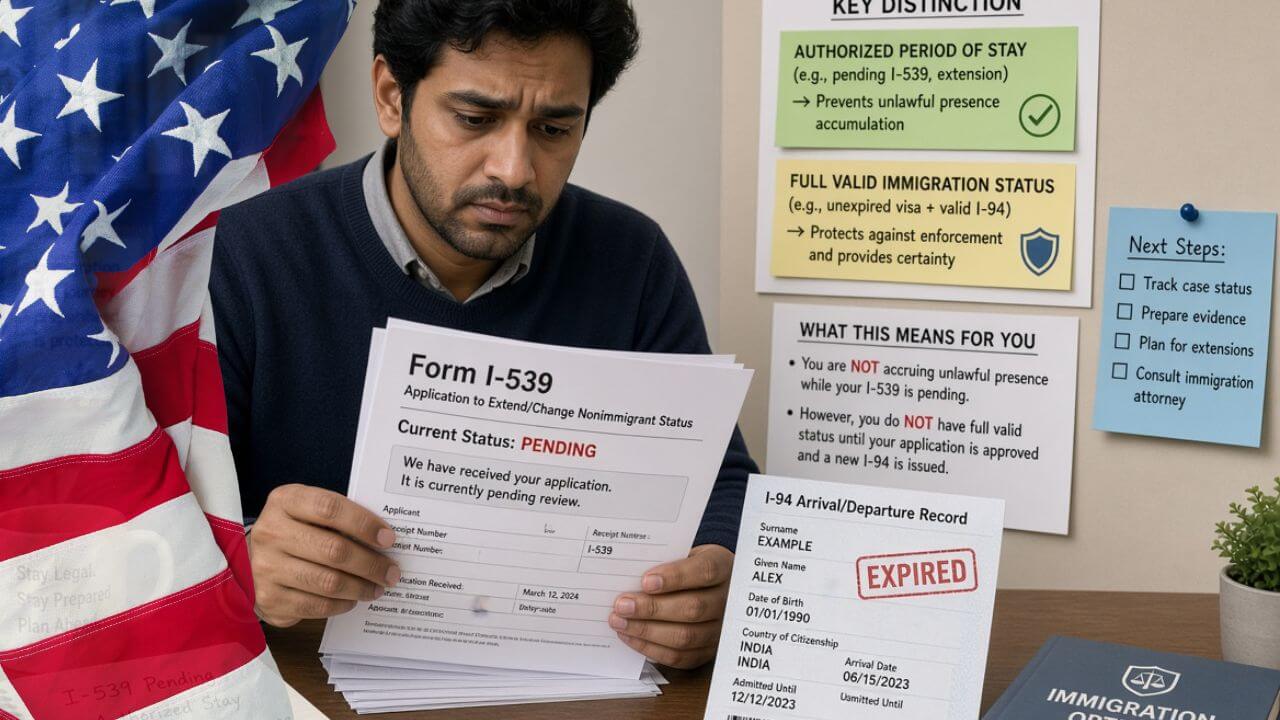
If you filed Form I-539 to change or extend your nonimmigrant status and your I-94 authorized stay has since expired while the case is still pending, you may have been told that you are in an authorized period of stay. That is technically accurate. But understanding exactly what that phrase means and, more importantly, what it does not protect you from is essential for anyone in this situation under the current administration.
What is an authorized period of stay and how does it work?
When you file Form I-539, which is the Application to Extend or Change Nonimmigrant Status, before your current authorized stay expires, USCIS grants you what is called an authorized period of stay for the duration that your application is pending. This is a formal recognition by the government that you are not simply overstaying without permission. You filed a timely application to change or extend your status and while that application is being reviewed you are considered to be in a legally recognized period of stay.
The most significant practical benefit of an authorized period of stay is its effect on unlawful presence. Unlawful presence is the accumulation of days spent in the United States without valid immigration status. These days matter enormously because of the bars they trigger when a person departs the country. If you accumulate more than 180 days of unlawful presence and then leave the United States, you face a three-year bar to re-entry. If you accumulate more than 365 days of unlawful presence and then leave, you face a ten-year bar. These bars are serious and can have permanent consequences for your immigration future.
Because an authorized period of stay is recognized by USCIS as a period in which your presence is legally authorized pending the adjudication of your application, those days do not count as unlawful presence. Your three-year and ten-year bar clocks are not running while you have a properly filed I-539 pending. That is the core legal benefit of being in an authorized period of stay.
What does an authorized period of stay not protect you from?
This is the part that many people in this situation do not fully understand, and under the current administration it is critically important. An authorized period of stay protects you from accumulating unlawful presence days. It does not grant you full valid status in the same way that an unexpired visa would. And it does not protect you from immigration enforcement.
Technically, once your I-94 has expired and your I-539 is pending, you are out of status even while being in an authorized period of stay. This distinction matters because immigration enforcement, specifically ICE, has the authority to detain and initiate removal proceedings against individuals who are out of status regardless of whether they have a pending application. The authorized period of stay does not function as a shield against an ICE encounter, a detention, or a referral to immigration court.
Historically, USCIS and ICE treated people with pending I-539 applications as low enforcement priorities. The combination of a timely filed application, an authorized period of stay, and no criminal history made these individuals essentially invisible to enforcement resources that were directed elsewhere. Going after someone with a pending application was considered a poor use of limited enforcement resources and was widely viewed as unfair given that the person had done the right thing by filing timely.
How has the current administration changed this calculus?
The Trump administration has significantly expanded immigration enforcement priorities and has made clear that it does not consider a pending application sufficient reason to protect someone from enforcement action. The historical presumption that someone with a pending I-539 would not be targeted for enforcement is no longer a reliable assumption.
This does not mean that everyone with a pending I-539 and an expired I-94 is at immediate risk of being detained. The practical reality is that enforcement resources are still finite and are generally directed toward individuals with criminal histories, prior removal orders, or other aggravating factors. But the categorical assurance that a pending application provides protection from enforcement that existed under prior administrations no longer holds.
Under the current administration, an ICE encounter for someone with a pending I-539 and an expired I-94 could lead to a detention and removal proceeding even without any other enforcement history. Whether that happens in any individual case depends on circumstances, priorities, and the specific facts of the encounter. But it can happen, and people in this situation need to understand that it can.
What should you do if you are in this situation?
The first thing is to understand your specific risk profile. Having a pending I-539, a clean background, no criminal history, and no prior immigration violations puts you in a significantly better position than someone with complicating factors. That does not mean you are immune from enforcement, but it does affect your realistic risk level under the current priorities.
The second thing is to stay in close contact with an immigration attorney who is monitoring your case and the current enforcement environment. If your I-539 has been pending for an extended period, your attorney can advise on whether any steps can be taken to follow up on the case, whether an expedite request is appropriate given your circumstances, and how to manage your situation while the case remains pending.
The third thing is to avoid situations that could create an ICE encounter. Avoiding situations that increase the likelihood of encountering law enforcement, keeping a low profile, and recognizing that the current environment requires more caution than under prior administrations are all practical steps. This can even mean visiting airports!
An authorized period of stay is a real and meaningful immigration protection for the specific purpose of preventing unlawful presence accumulation. It is not a guarantee of safety from enforcement in the current environment, and treating it as one could lead to a false sense of security that creates real risk.
Download our free Ultimate Naturalization Guide for Citizenship at JQKLaw.com/citizenship, join Attorney John Khosravi, Esq. live every Tuesday at 4 PM PT / 7 PM ET on YouTube, LinkedIn, Instagram, and TikTok for a free Q&A, or book a one-on-one consultation at JQKLaw.com/contact.

