
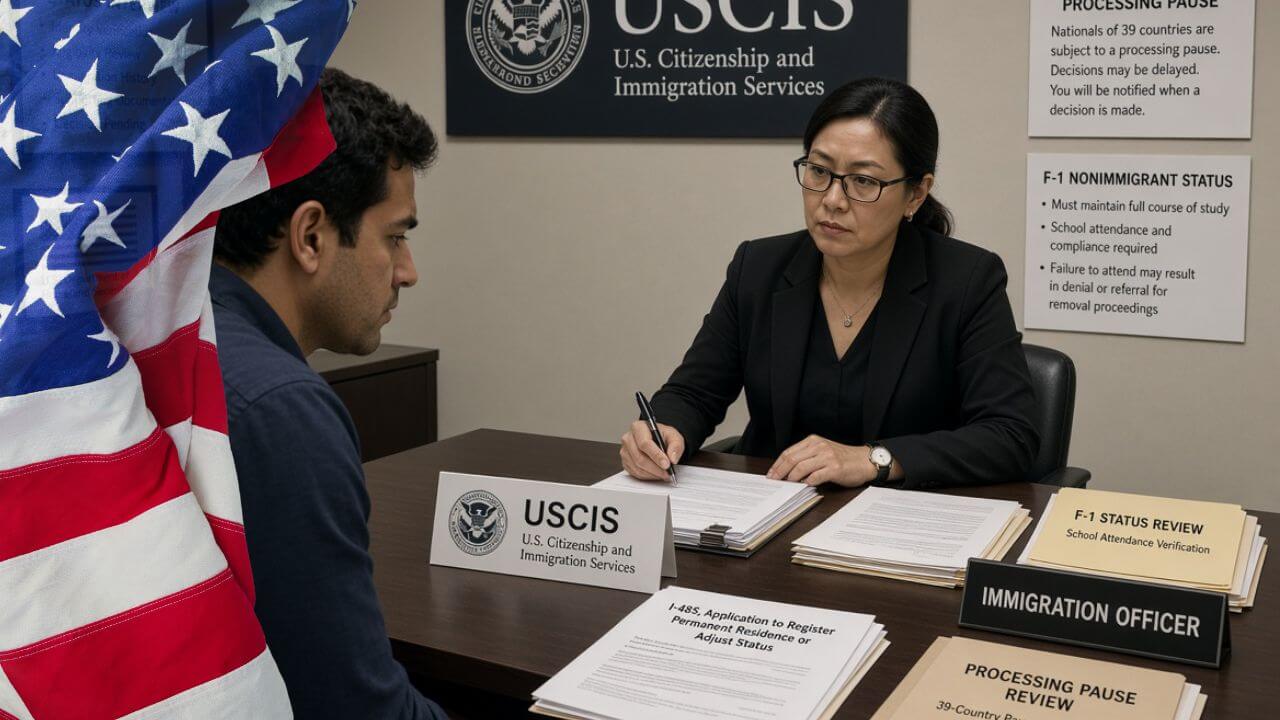
An issue is becoming increasingly common in immigration practice that everyone in these circumstances needs to understand before they walk into a USCIS interview. This involves people who entered the United States on an F-1 student visa but never actually attended school.
What happens at an adjustment of status interview if you entered on an F-1 but never went to school?
This is one of the most serious situations a green card applicant can be in right now, and it is happening more frequently than most people outside the immigration law community realize. If you entered the United States on an F-1 student visa, which is a visa specifically issued for the purpose of full-time study at an accredited institution, and you never actually enrolled or attended school, you have a significant problem when you apply for a green card and attend an adjustment of status interview.
The F-1 visa was issued to you for a specific and limited purpose: to study. When a USCIS officer reviewing your adjustment of status application looks at your immigration history and sees that you entered on an F-1 but have no record of attending school, the natural question that arises is why you obtained a student visa if you did not intend to study. The inference the officer is likely to draw is that the F-1 was used as a pretext, that you never intended to study, and that you used the student visa as a mechanism to enter the United States for a purpose that was not disclosed to the consular officer who issued the visa.
This is the definition of visa fraud. Using a visa for a purpose other than the one for which it was issued, or misrepresenting your intentions at the time of the visa application, is a serious ground of inadmissibility. Under the current administration, officers are scrutinizing adjustment of status cases more aggressively and are more willing to raise fraud-based bars to admission than in prior years. A person in this situation going into an adjustment of status interview in the current environment is in a genuinely difficult position.
What should you expect at the interview if you are in this situation?
If your interview is approaching and you are in this situation, the most important thing you can do before the interview is consult with an experienced immigration attorney immediately. Do not go into that interview without legal representation and without having had a thorough consultation about exactly how your case looks from the officer’s perspective and how to address the questions that are almost certain to come up.
The officer will ask about your visa history and your status during your time in the United States. The circumstances of your F-1 entry and your failure to attend school will need to be explained. Depending on the specific facts of your case, including why you obtained the F-1, what circumstances prevented you from studying, and what your actual activities were during your time in the United States, there may be explanations that an experienced attorney can help you present in the most accurate and favorable light. But there is no version of this situation that does not require very careful preparation and honest legal analysis before you sit down with the officer.
What is the overall takeaway?
Both of these situations reflect a harder and more unpredictable immigration environment than existed just a few years ago. If you are in either of them, the answer is the same. Get experienced legal representation, understand exactly what the risks are in your specific situation, and do not go into any immigration interview or proceeding without preparation that accounts for the current enforcement environment.
Download our free Ultimate Naturalization Guide for Citizenship at JQKLaw.com/citizenship, join Attorney John Khosravi, Esq. live every Tuesday at 4 PM PT / 7 PM ET on YouTube, LinkedIn, Instagram, and TikTok for a free Q&A, or book a one-on-one consultation at JQKLaw.com/contact.

