
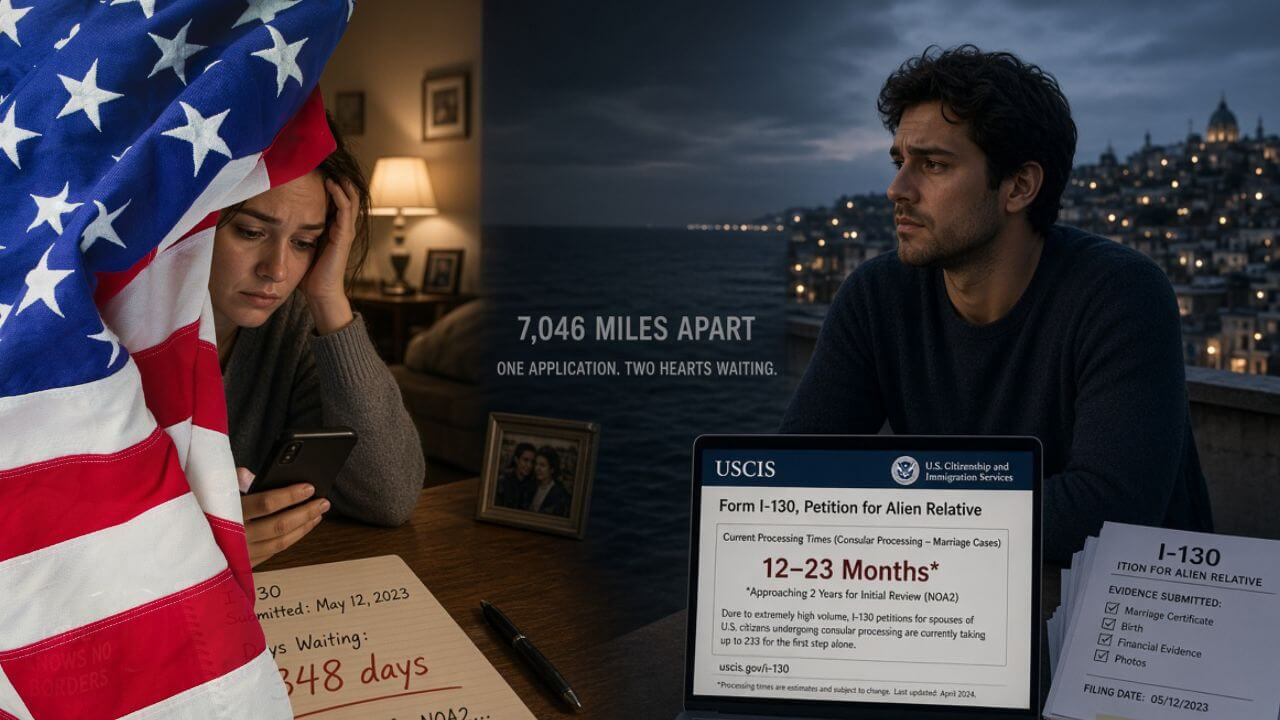
If you are a U.S. citizen who has filed or is planning to file a marriage green card case for a spouse who is outside the United States, the processing timeline you may have heard about or read about online is almost certainly outdated. The average time to get through the first critical step of the consular processing pathway has increased dramatically, and the trend is continuing in the wrong direction. Here is what is actually happening and what every couple in this situation needs to understand before setting expectations about when they will be reunited.
What is the I-130 and why does it take so long?
The foundational document in any family-based immigration case is the Form I-130, the Petition for Alien Relative. When a U.S. citizen files an I-130 for a spouse who is outside the United States, the petition establishes the qualifying relationship between the petitioner and the foreign national beneficiary. USCIS reviews the petition to confirm that the marriage is genuine and that the petitioner is a U.S. citizen. Once the I-130 is approved, the case moves to the National Visa Center and then to the U.S. embassy or consulate in the foreign spouse’s country for further processing and an interview.
The I-130 is just the first step. It does not grant a visa. It does not grant a green card. It simply establishes the relationship and opens the door to the rest of the process. And that first step alone is now taking significantly longer than it did just a few years ago.
How much longer are I-130 cases taking right now?
In our office, I-130 cases for U.S. citizen petitioners filing for foreign spouses through consular processing historically took between 12 and 15 months to be approved. A little over a year from filing to I-130 approval was the standard expectation that served couples well for years.
That timeline no longer applies. Cases that would have been approved within 12 to 15 months are now approaching two years without approval, and in some cases without any clear indication of when approval will come. The processing time increase is not modest. It is dramatic. And it is affecting cases across a wide range of countries including countries that have historically processed without difficulty.
A particularly striking example is the situation with Canadian spouses. Canada is not on any travel ban list. Canadian applicants do not typically face public charge issues. Canada is not associated with any national security concerns. And yet we currently have multiple clients whose U.S. citizen spouses are Canadian nationals living in Canada, whose I-130 cases are approaching the two-year mark without approval at just the first step of the process. Cases that should be among the most straightforward in the entire immigration system are experiencing the same dramatic delays as cases from countries with more complicated processing histories.
What happens if the foreign spouse is from a country subject to travel bans or public charge pauses?
For couples where the foreign spouse is a national of one of the countries subject to the current administration’s travel restrictions, the situation is even more complicated. The 39-country national security travel ban and the 75-country public charge pause have added layers of uncertainty and delay that go beyond standard processing time increases. For affected nationalities, the timeline for a complete marriage green card case through consular processing is genuinely unknown, potentially measured in years beyond the already extended standard processing times.
The combination of I-130 processing delays and travel ban complications means that couples in these situations are looking at extended separations that were not foreseeable when they began the process and that have no clear resolution date.
What about fiancé visa cases?
K-1 fiancé visa cases, which have historically been slightly faster than consular processing for married couples, have also slowed down significantly. The K-1 pathway is not immune to the processing time increases that are affecting the broader family-based immigration system. Couples who choose the fiancé visa pathway to avoid certain travel ban complications are still facing extended waits at multiple stages of the process.
There is also a form called the K-3 visa, a category designed to speed up the reunion of married couples while an I-130 is pending. In practice, the K-3 has not been a meaningful solution for most couples.
Is there anything that can speed up an I-130 case?
When the delay becomes extreme and nothing moves despite extended waiting, some couples and their attorneys pursue a federal court lawsuit against USCIS for unreasonable delay. These lawsuits, sometimes called mandamus actions, can in some cases prompt USCIS to act on a case that has been sitting without action. They can work. But they add cost, approval isn’t guaranteed, and they add another layer of stress and legal expense to an already difficult situation, requiring the couple to remain separated while the lawsuit proceeds.
What about cases filed for spouses of green card holders rather than U.S. citizens?
The situation for spouses of lawful permanent residents rather than U.S. citizens is even more constrained. Green card holder petitioners file in the F-2A preference category, which is subject to visa number availability in addition to standard processing times. Processing times in these cases are measured in years rather than months under current conditions, and the combination of category backlogs and current processing delays makes these among the most difficult timelines to predict or manage.
For green card holder petitioners who are approaching the point where they could naturalize and become U.S. citizens, pursuing naturalization is the most direct way to move their spouse’s case out of the preference category system and into the immediate relative category, which has no visa number backlog.
Download our free Ultimate Naturalization Guide for Citizenship at JQKLaw.com/citizenship, join Attorney John Khosravi, Esq. live every Tuesday at 4 PM PT / 7 PM ET on YouTube, LinkedIn, Instagram, and TikTok for a free Q&A, or book a one-on-one consultation at JQKLaw.com/contact.

