
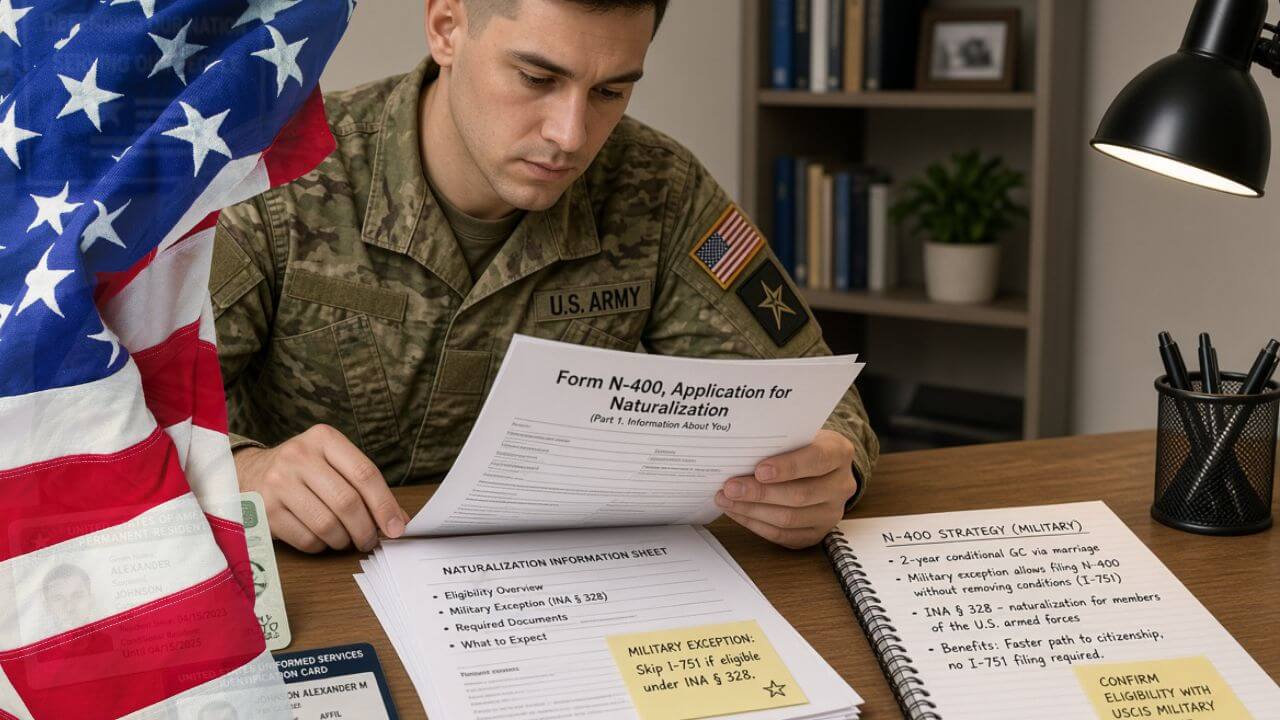
If you are an active duty U.S. military member and you received a two-year conditional green card through marriage, there is an important exception to the standard green card renewal process that most military families never hear about. Under specific circumstances, you may be able to bypass Form I-751 removal of conditions entirely skipping that step, saving the $750 government filing fee, and moving directly to a U.S. citizenship application instead.
This is not a widely publicized option, but for military members who qualify, it is one of the most significant immigration shortcuts available anywhere in U.S. immigration law.
What Is the Standard I-751 Removal of Conditions Process and Why Is It Such a Burden for Military Members?
For most conditional green card holders married to U.S. citizens, the standard process after receiving a two-year green card requires filing Form I-751, the Petition to Remove Conditions on Residence, within the 90-day window before the card expires. This converts the two-year conditional green card into a full 10-year permanent green card by demonstrating that the marriage was and remains genuine.
The I-751 process carries a current government filing fee of $750, requires substantial documentation of the ongoing marriage, involves another round of biometrics, and currently takes anywhere from two to three years to be adjudicated at most USCIS field offices. For a military member who may be deployed, stationed overseas, or in the middle of active service, coordinating this filing gathering joint financial records, submitting to biometrics appointments, monitoring case status is a significant administrative burden on top of an already demanding military life.
The good news is that Congress recognized this burden and built in an exception specifically for military members that eliminates the need to go through this process at all in many cases.
What Is the Military Exception to the I-751 Removal of Conditions Requirement?
The United States has been in a congressionally declared state of war or armed conflict continuously since 2001. That sustained period of military engagement triggers a specific provision of U.S. immigration law that creates an expedited naturalization pathway for military members and embedded within that pathway is the ability to bypass the I-751 removal of conditions step entirely.
Under this provision, a military member who received a conditional green card through marriage and who has been enlisted or serving during the current period of hostilities may be able to file directly for U.S. citizenship through naturalization without first filing the I-751 to remove conditions on their green card. The two-year conditional green card does not need to be converted to a 10-year card as a prerequisite. The military member can jump straight from the conditional green card to the naturalization application.
This applies to the majority of military members who find themselves in this situation though as with any immigration benefit, there are individual circumstances and edge cases where the exception may not apply cleanly. Consulting with an experienced immigration attorney before proceeding is essential to confirm that your specific history and background make you a strong candidate for this pathway.
What Citizenship Requirements Do Military Members Still Need to Meet to Use This Exception?
Bypassing the I-751 does not mean bypassing all requirements for U.S. citizenship. Military members using this exception still need to satisfy certain naturalization requirements just not all of them.
Good moral character remains a universal requirement for naturalization and cannot be waived. This means your background, including any arrest history, criminal record, immigration violations, or other conduct that could reflect on your moral character, will be reviewed as part of the naturalization process. A clean background history is essential for this pathway to work smoothly.
One of the most significant requirements that may be waived or modified for military members is the physical presence requirement. Standard naturalization requires applicants to have been physically present in the United States for a specific period of time as a lawful permanent resident. For military members who have been deployed overseas or stationed outside the U.S. during their service, meeting the standard physical presence requirement would be difficult or impossible. The military exception addresses this by relaxing or eliminating the physical presence requirement in recognition of the demands of military service.
The continuous residence requirement and other standard naturalization elements may also be treated differently for qualifying military members. An immigration attorney familiar with military naturalization cases can walk through exactly which requirements apply to your specific situation and which are waived or modified under the military exception.
What Background and Immigration History Issues Could Affect a Military Member’s Ability to Use This Exception?
Before pursuing this pathway, there are several areas of your immigration and personal history that need to be carefully reviewed.
First, the original green card needs to have been obtained properly and legitimately. If there were any issues with the underlying marriage-based green card application misrepresentations, incomplete disclosures, or procedural problems those issues need to be identified and addressed before moving forward with a naturalization application that skips the I-751 step.
Second, any arrest history even arrests that did not result in convictions, and even minor incidents, needs to be disclosed and evaluated. Immigration law treats arrest history seriously, and what might seem like an insignificant old matter can create complications in a naturalization application if it is not properly handled and disclosed upfront.
Third, any prior immigration violations or gaps in status need to be accounted for. The naturalization application requires a thorough accounting of your immigration history, and inconsistencies or omissions are treated as serious problems by USCIS adjudicators.
The goal of the pre-application review is not to find reasons why this pathway won’t work it’s to identify any potential issues in advance so they can be addressed proactively rather than surfacing as surprises during the naturalization interview.
Why Is This Military Exception to I-751 Removal of Conditions So Significant for Military Families?
The practical benefits of this exception for qualifying military members are substantial. Skipping the I-751 means avoiding the $750 government filing fee for that form. It means not spending two to three years waiting for a removal of conditions decision while managing the demands of military service. It means one fewer round of biometrics, one fewer set of documents to gather, and one fewer USCIS application to monitor and manage.
For a military family that is already navigating deployments, relocations, and the general complexity of military life, eliminating an entire major immigration step is not a minor convenience it is a meaningful reduction in the administrative burden that military service places on families who are already giving an enormous amount.
If you are an active-duty military member with a two-year conditional green card, this option deserves a serious conversation with an experienced immigration attorney who handles military naturalization cases. Most military members in this situation have never been told this pathway exists and that is exactly why it matters to know about it.
Join Attorney John Khosravi, Esq. live every Tuesday at 4 PM PT / 7 PM ET on YouTube, LinkedIn, Instagram, and TikTok for a free Q&A, or book a one-on-one consultation at JQKLaw.com/contact.

