
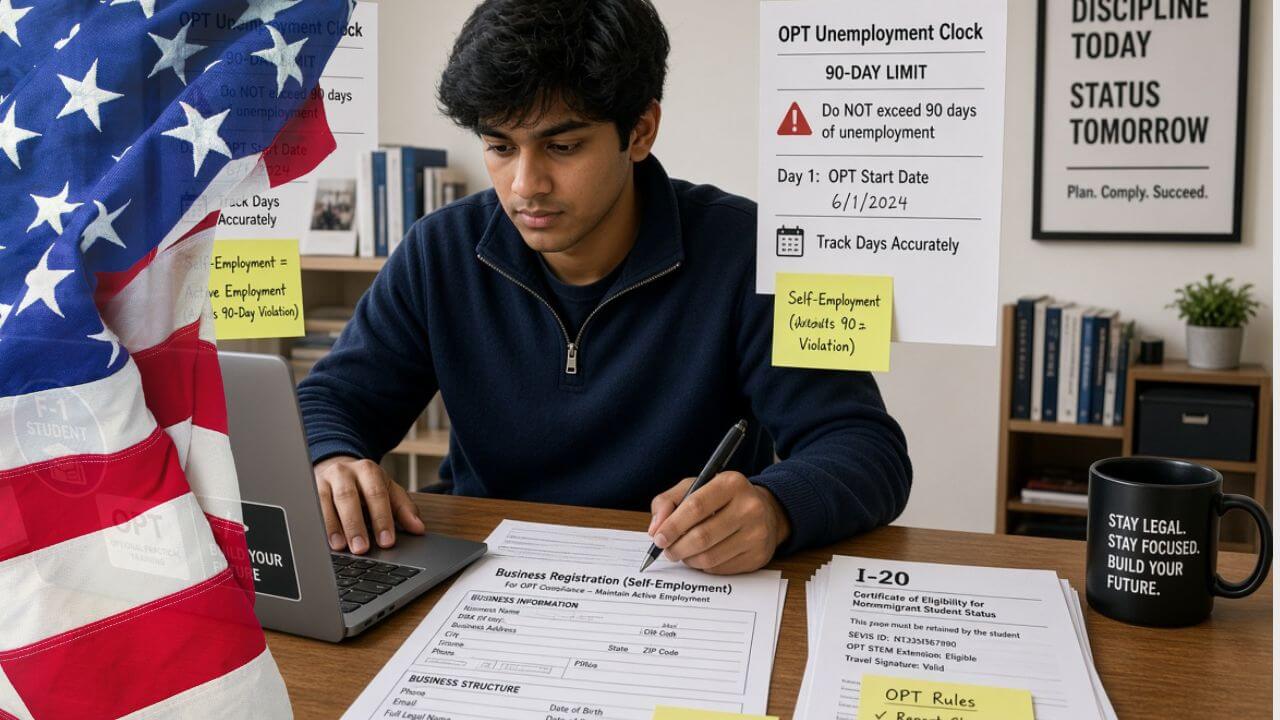
If you are an F-1 student visa holder on Optional Practical Training and you are running out of time to find a job or you were laid off and the 90-day unemployment clock is ticking the pressure can feel overwhelming. Many students in this situation make one of two costly mistakes: they either let the 90-day unemployment period run out without taking action, or they leave the United States entirely out of fear that they have no other options.
Both of those choices are unnecessary. There is a legitimate, legal, and underutilized option available to F-1 OPT holders that most students and even some advisors don’t know about. You can start your own business.
Here is how OPT self-employment works, what it requires, and why it might be exactly the lifeline you need right now.
What Is the 90-Day OPT Unemployment Rule and What Happens if You Exceed It?
Optional Practical Training gives F-1 student visa holders the ability to work in the United States in a field directly related to their major for up to 12 months after completing their degree. It is one of the most valuable immigration benefits available to international students but it comes with a strict unemployment limit that many students underestimate.
Under OPT rules, you are allowed a maximum of 90 days of unemployment during your standard OPT period. That means 90 cumulative days without authorized employment not 90 consecutive days. Once you exceed that limit, you are in violation of your F-1 status. That violation does not just affect your current OPT authorization it can affect every future visa application, green card petition, and immigration benefit you apply for, potentially for the rest of your life.
This is not a technicality to overlook. USCIS and consular officers reviewing future applications can and do ask about past immigration violations, and a status violation during OPT is exactly the kind of thing that raises flags and requires explanation years down the road.
Does OPT Allow Self-Employment and Can Starting a Business Count as Authorized OPT Work?
Yes, and this is the part that most F-1 students on OPT don’t know. Standard first-year OPT does allow self-employment as a legitimate form of authorized practical training, provided the business is in a field directly related to your area of study. You do not need an employer to sponsor you. You do not need a job offer. You can create your own employment by establishing and operating a business in your field.
This means an engineering graduate could launch an engineering consulting practice. A computer science graduate could start a software development company. A business graduate could establish a marketing or consulting firm. The key requirement is that the work you are doing through the business must genuinely relate to your major self-employment in an unrelated field does not satisfy the OPT work requirement.
What is equally important to understand is that you do not need to be generating revenue in the first year for the self-employment to count. USCIS recognizes that new businesses take time to become profitable. What matters is that you are actively engaged in legitimate business operations and working full-time in the development of the enterprise.
What Documentation Do You Need to Prove OPT Self-Employment Is Legitimate?
Documentation is everything in an OPT self-employment situation and this is where many students fall short even when their intentions are entirely legitimate. Because you are your own employer, there is no W-2, no employer letter, and no traditional paper trail that automatically proves you were working. You have to create that paper trail yourself, deliberately and consistently, from day one.
Strong documentation for OPT self-employment typically includes official business registration records forming an LLC or corporation with the state creates a timestamped legal record of when the business was established. Business banking records, even if the balances are small in the early stages, demonstrate that the business is real. Emails and communications with potential clients, vendors, partners, or industry contacts show active business development efforts. Contracts, proposals, invoices, and service agreements even ones that didn’t result in paid work document that you were pursuing legitimate business activities. A business website, social media presence, or any public-facing business identity also helps establish the legitimacy and timeline of the operation.
The standard you are documenting toward is straightforward: if a USCIS officer or a consular officer reviewing a future visa application asks how you spent your OPT period, you want to be able to show a clear, organized, and credible record of full-time business activity in your field of study.
Why Should F-1 OPT Students Never Leave the U.S. Just Because They Cannot Find a Job?
This is one of the most common and most avoidable mistakes F-1 students make when they hit the job search wall during OPT. The fear is understandable if the 90-day deadline is approaching and there is no job offer in sight, leaving the country can feel like the responsible thing to do. It is not.
Leaving the United States while on OPT without a plan to return essentially abandons your OPT authorization and your F-1 status. It eliminates the option of self-employment. And it puts you back at square one without any of the time, effort, and networking you invested during your degree program and job search.
Self-employment during OPT keeps you in the United States, keeps you in legal status, keeps you active in your professional field, and critically keeps you in the environment where career opportunities actually exist. Running a small business in your field, even in its early stages, puts you in contact with people in your industry. Potential employers, clients, collaborators, and mentors become part of your professional network. Many students who have pursued OPT self-employment have been hired by contacts they made while building their business contacts they would never have met if they had left the country.
What Is the Difference Between Standard OPT Self-Employment and STEM OPT and Why Does It Matter?
It is critical to understand that the self-employment flexibility described above applies to standard first-year OPT. STEM OPT the 24-month extension available to graduates of qualifying science, technology, engineering, and mathematics programs, has significantly different and stricter requirements.
STEM OPT requires that you work for an employer enrolled in the E-Verify system. Self-employment does not satisfy the STEM OPT work requirement in the same way it satisfies standard OPT, because a business you own and operate yourself generally cannot serve as its own E-Verify employer for STEM OPT purposes. If you are approaching the end of your standard OPT period and are considering a STEM OPT extension, the self-employment strategy needs to transition into a traditional employer relationship before the STEM OPT period begins.
This distinction makes the timing and planning of OPT self-employment even more important. Use the standard OPT period to build the business, make industry connections, and pursue job opportunities with the goal of transitioning to traditional employment that can support a STEM OPT extension if applicable to your situation.
What Should F-1 OPT Students Do Right Now if They Are Approaching the 90-Day Unemployment Limit?
First, talk to your Designated School Official immediately. Your DSO is your first point of contact for OPT questions and can advise on how self-employment should be reported and documented within your school’s OPT tracking system. Getting your DSO aligned with your self-employment plan from the beginning is essential.
Second, consult an experienced immigration attorney. OPT self-employment is legitimate and well-established, but it needs to be done correctly and documented properly to hold up under future scrutiny. An immigration attorney can help you structure the self-employment, identify what documentation to create and maintain, and make sure the entire OPT period is clean and defensible for every future immigration application you file.
The goal is not just to survive the 90-day unemployment window. It is to build a record that you did everything by the book because that record will follow you through every visa application, every green card petition, and every immigration interaction for the rest of your life in the U.S.
To schedule a private video consultation with Attorney John Khosravi and the JQK Law team, visit JQKLaw.com/contact. Join the free weekly immigration Q&A every Tuesday at 4 PM PT / 7 PM ET on YouTube, Linkedin, and TikTok at @jqklawfirm. For additional resources including a free 70+ page Ultimate Marriage Green Card Guide, visit marriageimmigrationlaw.com.

