
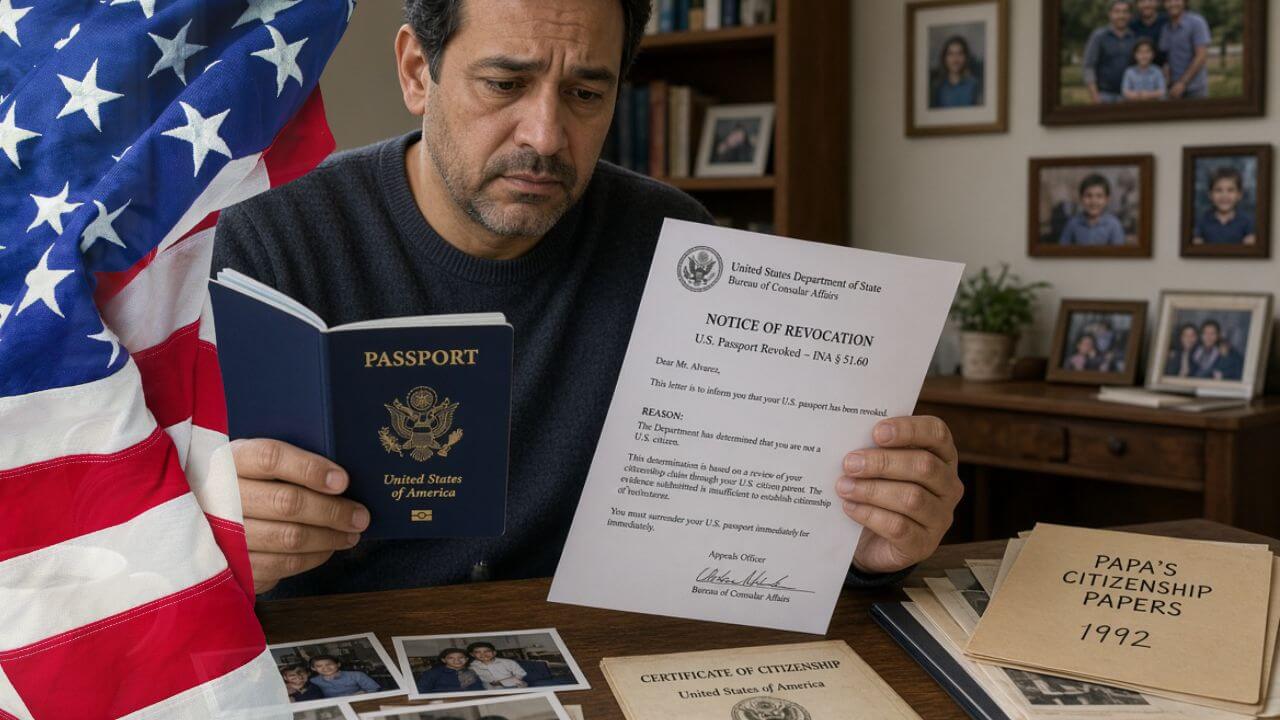
A person born overseas to one U.S. citizen parent and one non-citizen parent obtained a U.S. passport, lived their life assuming they were a U.S. citizen, and then years later had that passport revoked by the State Department on the grounds that it was issued in error. In one case, this happened when the person was 15 years old. In others, it has happened to adults who were 40 or 50 years old when the government came back and said the citizenship was never valid.
This is not a hypothetical. This is happening to real families right now and more people are in this situation than most people realize.
Is it actually possible for the government to take away a passport that was already issued?
Yes. This is the part that many people find difficult to accept. The common assumption is that once a U.S. passport has been issued, it represents a final determination that the holder is a U.S. citizen and that status is settled. That assumption is incorrect.
The State Department has the authority to revoke a U.S. passport if it determines that the passport was issued in error. If a person received a passport without actually meeting the legal requirements for U.S. citizenship at birth, the State Department can later determine that the issuance was a mistake and cancel the passport. The fact that the passport was issued, that the person used it, that years have passed, and even that the person has lived their entire life believing they were a citizen does not prevent the revocation from happening.
This is not a new legal principle. What is new is the increasing frequency with which it is occurring and the number of families discovering that their citizenship, which they believed to be settled, is now being challenged.
What is the legal standard for citizenship when born overseas to one U.S. citizen parent?
This is where the law is more complicated than most people realize, and where many of the errors that lead to improper passport issuances originate. Citizenship at birth for a person born outside the United States to one U.S. citizen parent and one non-citizen parent is not automatic. It depends on meeting specific statutory requirements that have varied over time depending on when the child was born.
The requirements generally involve the U.S. citizen parent having been physically present in the United States for a specified period of time before the child’s birth. The exact requirements depend on the law that was in effect at the time of the child’s birth, the marital status of the parents, and whether the U.S. citizen parent was the mother or the father. These rules have changed multiple times over the decades, and the applicable law depends on the specific birth date of the child.
If the U.S. citizen parent did not meet the physical presence requirement that applied at the time of the child’s birth, the child did not acquire U.S. citizenship at birth regardless of what any subsequent passport application may have represented. If a passport was issued based on an incorrect assessment of whether those requirements were met, the State Department can and does revoke it when the error is discovered.
Why does this keep happening?
The State Department processes large volumes of Consular Report of Birth Abroad applications and passport applications for people born overseas. In some of these cases, the physical presence requirements of the U.S. citizen parent are not properly verified at the time of the application. A passport is issued. The family moves on. Years pass.
The errors come to light in various ways. A more thorough review during a passport renewal, a consular officer who applies a more rigorous standard, a database cross-reference that was not previously done, or an audit of prior issuances can all surface cases where citizenship was incorrectly granted. When the error is identified, the revocation process begins.
The time elapsed between the incorrect issuance and the revocation can be enormous. People who received passports as infants or young children may be adults, even middle-aged adults, before the government identifies the error and acts on it. The disruption to the affected person’s life can be devastating.
What should you do if you or a family member was born overseas to one U.S. citizen parent?
The most important step is to have the citizenship documentation reviewed by an experienced immigration attorney to confirm that the citizenship was acquired correctly under the law that applied at the time of birth. This means verifying that the U.S. citizen parent met the physical presence requirements, that the documentation supports those requirements, and that the passport was issued on a correct legal basis rather than on assumptions that may not hold up to scrutiny.
If there is any uncertainty about whether the requirements were properly met, addressing it proactively is significantly better than discovering the problem later during a passport renewal, a border crossing, or a government audit. The consequences of having citizenship revoked as an adult after a lifetime of believing you were a citizen are severe. The legal pathway to correcting the situation is complex, expensive, and uncertain.
If you received a U.S. passport based on a parent’s citizenship and you have never had the underlying legal basis for that citizenship formally analyzed, now is the time to do that analysis.
What is the overall lesson from these eleven families?
Receiving a U.S. passport is not the same thing as having a legally secure claim to U.S. citizenship. For people born overseas to one U.S. citizen parent, the citizenship was either acquired at birth under the applicable law or it was not. A passport that was issued without verifying the underlying requirements is a passport that can be revoked. The government does not have a statute of limitations on correcting its own errors.
Get the analysis done now rather than waiting to find out the hard way.
Download our free Ultimate Naturalization Guide for Citizenship at JQKLaw.com/citizenship, join Attorney John Khosravi, Esq. live every Tuesday at 4 PM PT / 7 PM ET on YouTube, LinkedIn, Instagram, and TikTok for a free Q&A, or book a one-on-one consultation at JQKLaw.com/contact.

